

*Worth hearing
**Recommended
***Essential listening
CHORAL CDs
***
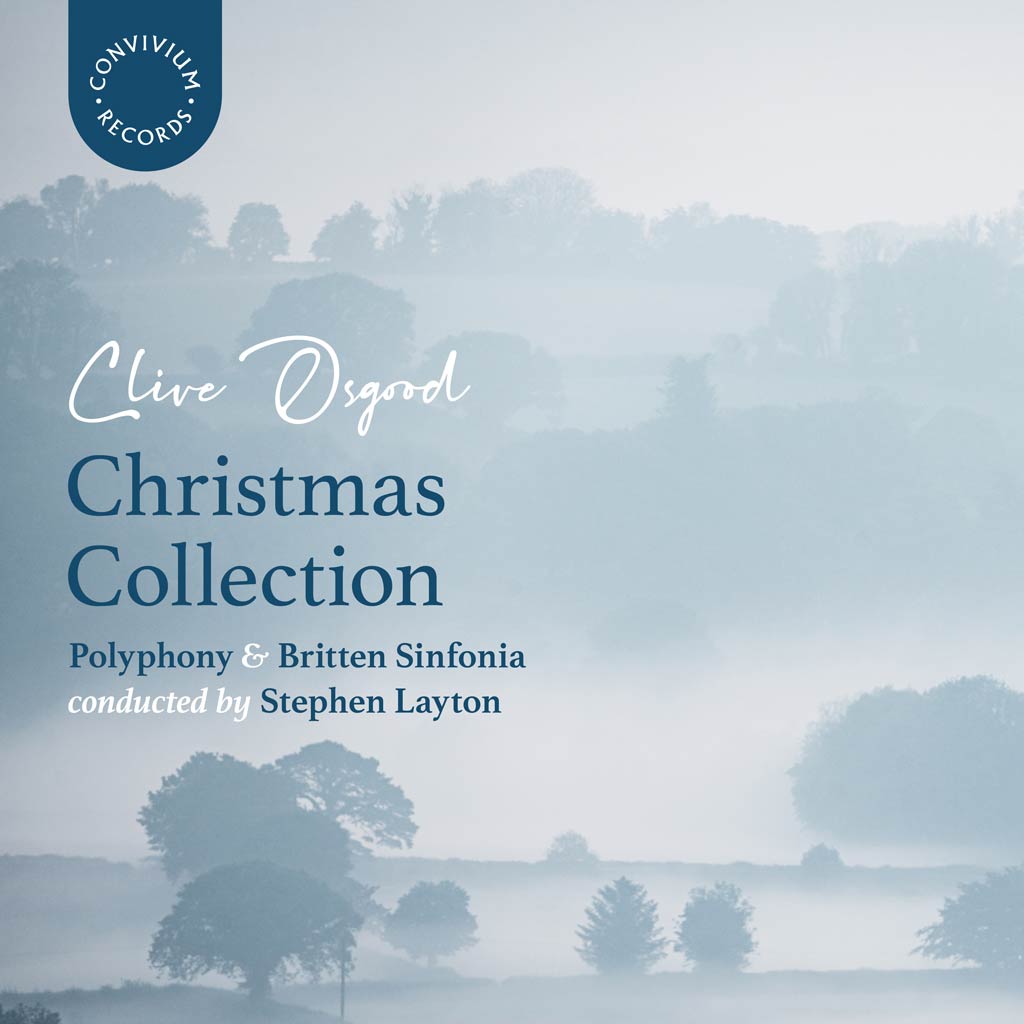
CLIVE OSGOOD: CHRISTMAS COLLECTION
Polyphony / Britten Sinfonia / Stephen Layton ♦ Convivium CR106
Five arrangements of carols from Piae Cantiones (1582) are preceded by five original settings for unaccompanied choir of traditional carol lyrics, forming a collection of just 10 carols on this 25-minute CD. All, however, are well worth listening to, varied in their often unexpected approaches to the words, and with performances as superb as one would expect from these performers.
Although there are several beautiful and gentle carol treatments, it is the high-spirited settings that leave the strongest impression, including the opening Hodie Christus natus est, an original Adam lay y’bounden with emphatic ‘Deo gratias’, and a final, wild treatment of Up! Good Christien folk. The Coventry Carol is notable for its violent depiction of the slaughter of the young children, followed by an impassioned solo soprano lament. The first of the arrangements, Omnis mundus, is of a carol not as well known as the others – it receives an attractively warm and thoughtful treatment. The final three carols form a single work, Sinfonia Cantiones, with choir accompanied by the Britten Sinfonia, including some notable wind solos. The CD may be short, but it is highly satisfying and, arguably, the length one needs to avoid a Christmas surfeit.
**
WELCOME YULE: A CHORISTER’S CHRISTMAS
Choristers and Schola of St Patrick’s Cathedral, Dublin / David Leigh (piano and organ) / Tom Little (piano) / Tanya Houghton (harp) / Bernard Reilly, Richard O’Donnell (percussion) / Stuart Nicholson ♦ Regent REGCD587
The choir of St Patrick’s Cathedral, Dublin comprises boy and girl choristers, a ‘schola’ of senior girls, and eight professional ‘lay vicars choral’. This sparkling carol collection features piano duet and percussion accompaniment in John Gardner’s Tomorrow shall be my dancing day and William Mathias’s sequence of seven carols, Salvator mundi. Tanya Houghton’s harp accompanies John Rutter’s eight-carol sequence, Dancing Day. There are solo organ pieces by Mathias (Toccata giocosa) and Gerald Near (Carillon on a Ukrainian carol). The disc concludes with a tender arrangement of the Wexford Carol followed by a riotous arrangement of I saw three ships come sailing in from the choir’s director, Stuart Nicholson. The bright sound of the singers, on their home ground with music that they obviously know well and enjoy singing, contributes to enthusiastic and joyful performances.

**
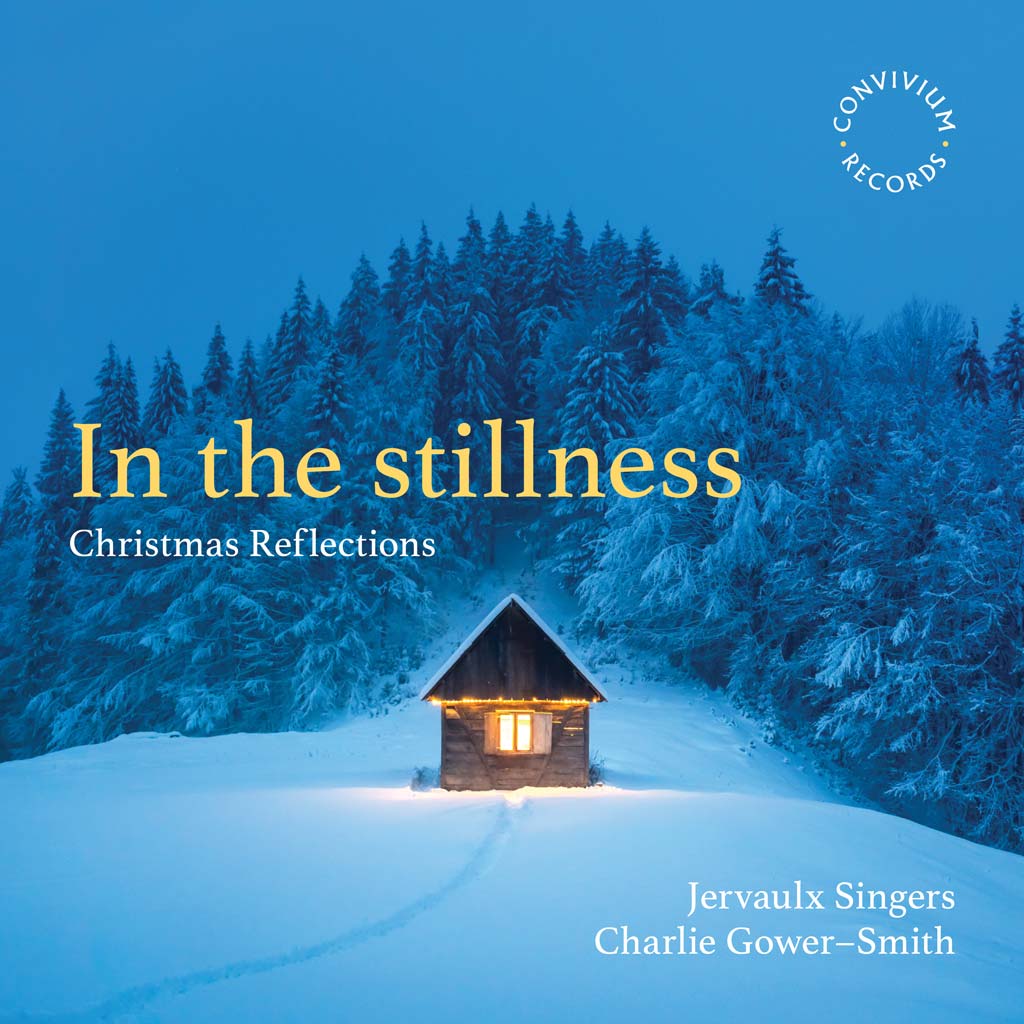
IN THE STILLNESS: CHRISTMAS REFLECTIONS
Jervaulx Singers / Alison Frances Gill (piano) / Charlie Gower-Smith ♦ Convivium CR113
The Jervaulx Singers, formed in 2021, are eight professional singers, named after Jervaulx Abbey in North Yorkshire. They are versatile enough to cover standard church choir repertoire (Elizabeth Poston’s Jesus Christ the apple tree receives a stand-out performance here) and include plenty from the initial Carols for Choirs volumes, but also an exciting range of other Christmas music – not carols at all, but justifying the subtitle ‘Christmas reflections’. Debussy’s Noël des enfants qui n’ont plus de maisons is a striking piece composed during the First World War. With an angry text and hard, driven accompaniment, children sing at Christmas time about the destruction of their homes, school and church. It was Debussy’s final solo-voice mélodie, sung here in the composer’s upper-voice chorus version.
Of two pieces sung by solo voices, Fauré’s Noël describes the visit of the magi with their gifts to the infant Jesus and urges us to ‘imitate their pious example’. ‘Must the winter come so soon?’ is Erika’s opening aria in Samuel Barber’s opera Vanessa. Its gentle, beautiful melancholy may have little to do with Christmas, but evokes a seasonal stillness. A short carol, In the stillness by Sally Beamish with words by Katrina Shepherd, provides the title track: it is a real ‘Christmas reflection’, evoking a winter scene with soft, fresh snow and candles glowing in a church, as we wait for a ‘child soon to be born’. The whole CD is a varied tour through unexpected seasonal landscapes, imaginatively chosen and beautifully sung.
Judith Markwith
**
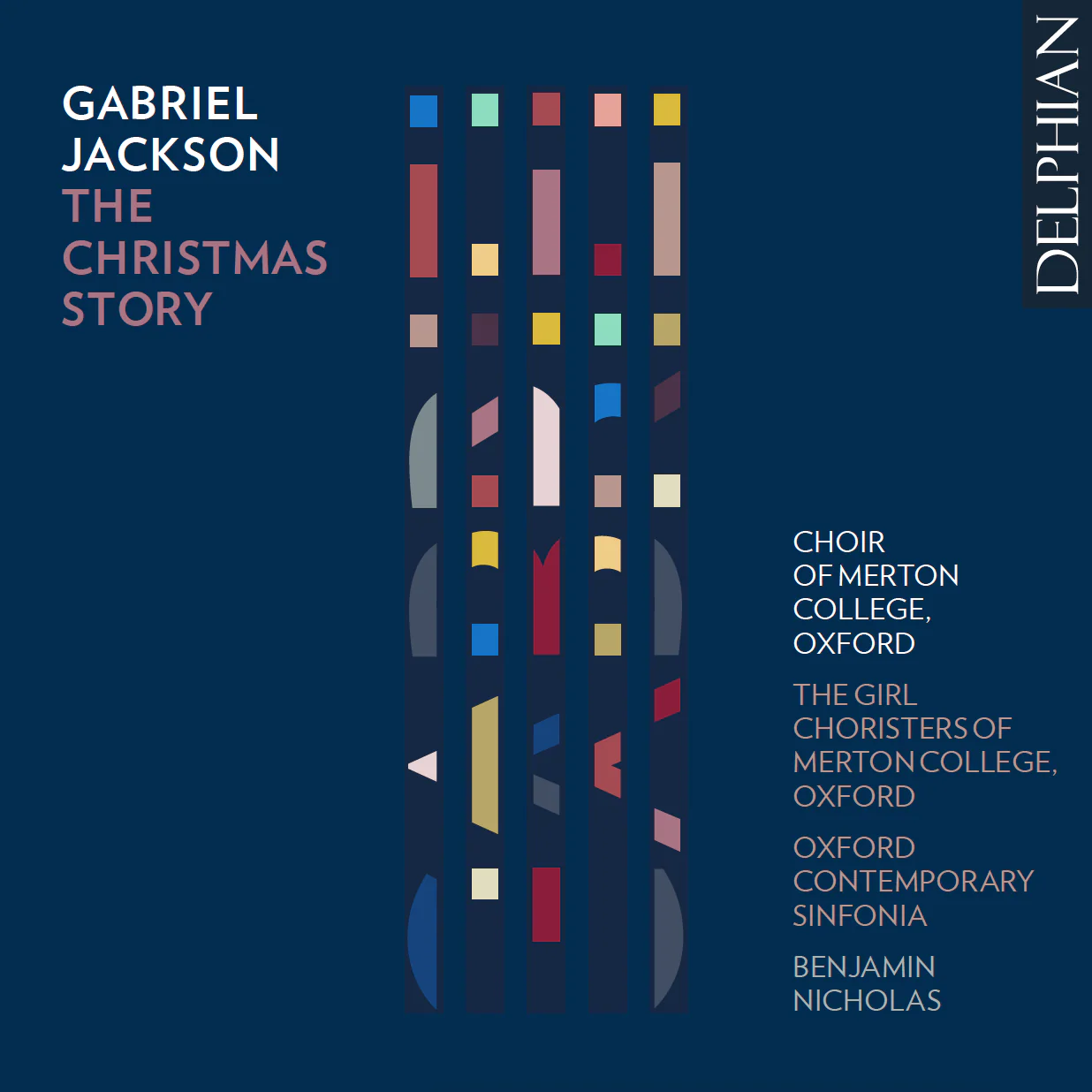
GABRIEL JACKSON: THE CHRISTMAS STORY
Choir and Girl Choristers of Merton College, Oxford / Owen Chan, François Cloete (organ) / Oxford Contemporary Sinfonia / Benjamin Nicholas ♦ Delphian DCD34331
Advent, Christmas, Epiphany and finally Candlemas structure the four parts of this bewitching work, with 26 pieces of music including Gospel settings, motets, antiphons and responsories. There are musical settings of four new poems: Expecting (for Advent), Lullaby of the beasts (Christmas), A guest at Cana (Epiphany) and Anna’s Song (Candlemas), sung by the college’s girl choristers with organ accompaniment. The rest of the work is scored for the full choir with flute, percussion, strings, saxophone and three trombones. All come together for a final O nata lux de lumine that starts as if plainchant, but is in fact newly composed. Add a jubilant solo organ toccata to conclude the Christmas section, Latin hymns and dance-like sections (including inebriation at Cana) – there is a wonderful mix of music and drama. It includes a setting of the Epiphany antiphon Tribus miraculis as a two-minute unaccompanied SATB anthem.
Julian Elloway
HERBERT HOWELLS CD
***
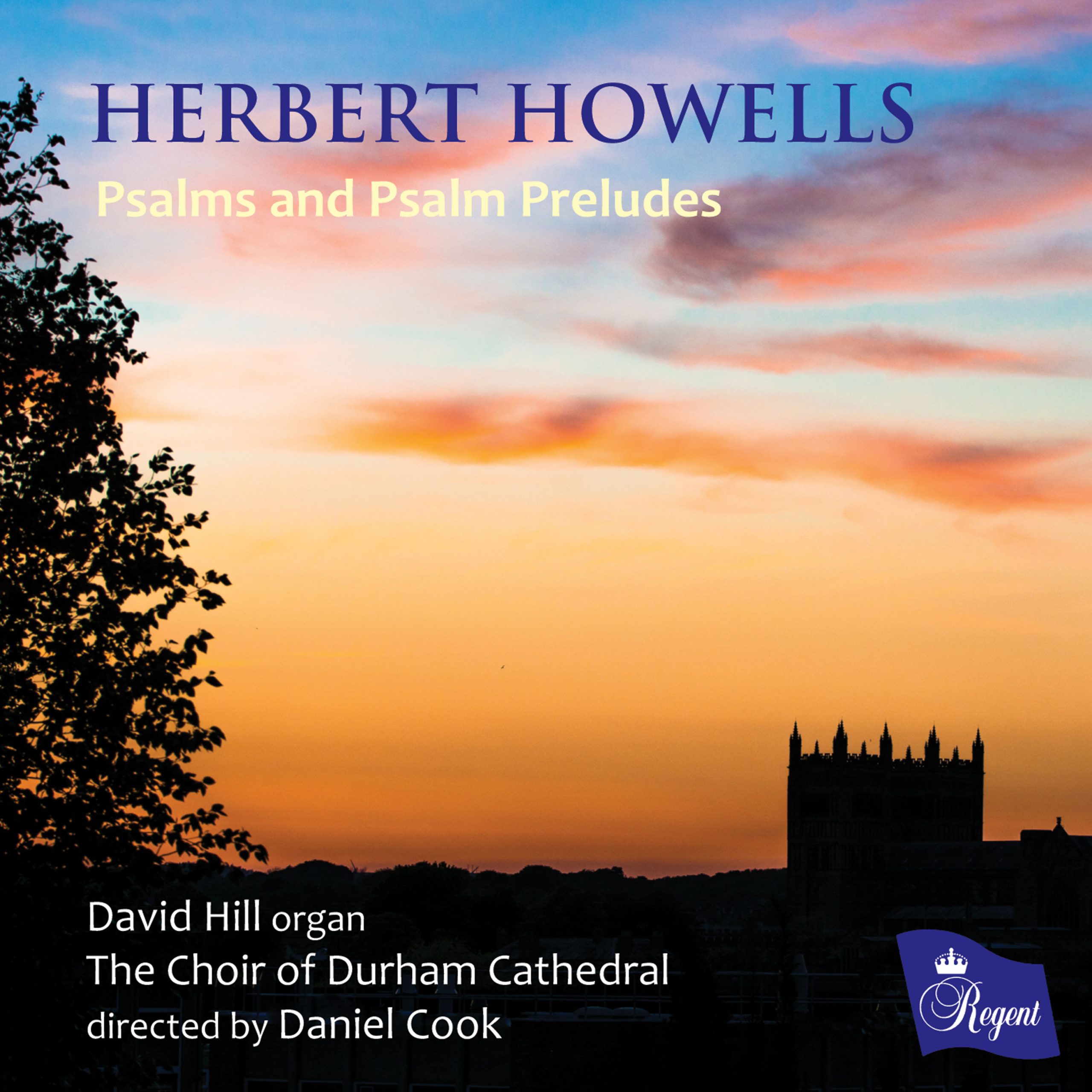
HERBERT HOWELLS: PSALMS AND PSALM PRELUDES
David Hill plays the organ of Durham Cathedral / Choir of Durham Cathedral / Joseph Beech (organ) / Daniel Cook ♦ Regent REGCD586
This is a double recording project, with the results interleaved to form a Howells sequence. David Hill plays Howells’s six Psalm Preludes on the Durham organ. Before each, we hear the psalm that inspired it, using psalm chants by Howells and sung by the cathedral choir with their current sub-organist, Joseph Beech, directed by Daniel Cook. It is an excellent idea. and works exceptionally well with these performers, including David Hill who was once sub-organist there.
There are 10 known chants by Howells, all of which are heard on this disc, several receiving their first recording. The informative and very readable notes by Jonathan Clinch describe how the composer wrote several of the chants on the backs of used envelopes and gave them straight to friends: he did not attempt to retain them. The words of the psalms were of great importance to him, despite his own lack of conventional faith. As is often noted, the two sets of psalm preludes were written 20 years apart, the second set after the death of Howells’s son, Michael. The first of the second set is inspired by the opening of Psalm 130, ‘Out of the deep have I called unto thee, O Lord’. The psalm is set to a chant that is chromatic and dark-coloured, matching the darkness of the opening of the psalm prelude. The disc opens with David Hill playing Master Tallis’s Testament. His playing throughout is magisterial; in the psalms, choir and organist perform with the utmost sensitivity – understated, and contrasting with the great climaxes of the psalm preludes. Every Howells enthusiast should buy this trail-blazing CD.
Judith Markwith
ORGAN CD
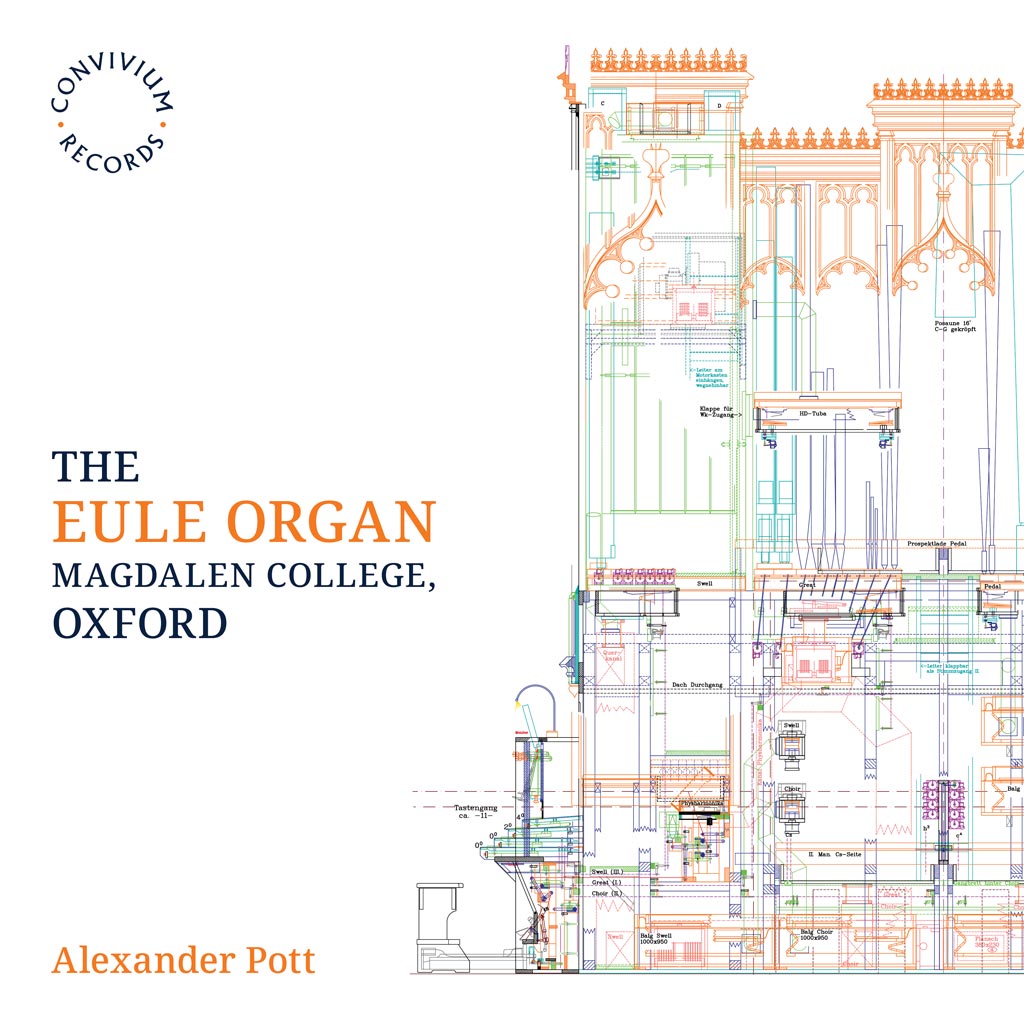
THE EULE ORGAN: MAGDALEN COLLEGE, OXFORD
Alexander Pott plays the Hermann Eule organ in Magdalen College, Oxford ♦ Convivium CR109
The 2023 Eule organ replaced an earlier Mander instrument at Magdalen College. Its 45 stops reflect a German Saxon heritage, and this, its first commercial recording, features music with connections to Leipzig and wider Saxony, from the middle of the 19th into the early 20th century. The disc opens with transcriptions, Jeanne Demessieux’s of Liszt’s Funérailles (originally for piano) and Liszt’s transcription of Wagner’s ‘Pilgrim’s Chorus’ from Tannhäuser.
Original organ music starts with Reinecke’s Organ Sonata in G minor, which culminates with the chorale ‘Wie schön leuchtet der Morgenstern’. Ethel Smyth studied in Leipzig and shortly after wrote her Prelude and Fugue on ‘O Traurigkeit, O Herzeleid’. Sigfrid Karg-Elert’s The Reed-grown Waters gives an opportunity to hear the only example in the UK of a Physharmonica stop. We move on through Delius as arranged by Eric Fenby and Percy Whitlock, to Percy Grainger with The Immovable Do, where the note C is sustained throughout by a pencil jammed between the keys. The organist on this disc, Alexander Pott, has arranged Peter Warlock’s five Folk-Song Preludes (originally for piano), which are followed by the first recording of Frederic Austin’s Organ Sonata to conclude the recital.
Alexander Pott knows this organ well: he imaginatively shows off its range of romantic tone colours. The packaging is generous, with notes that include a history and specification of the instrument.
Julian Elloway
BOOKS
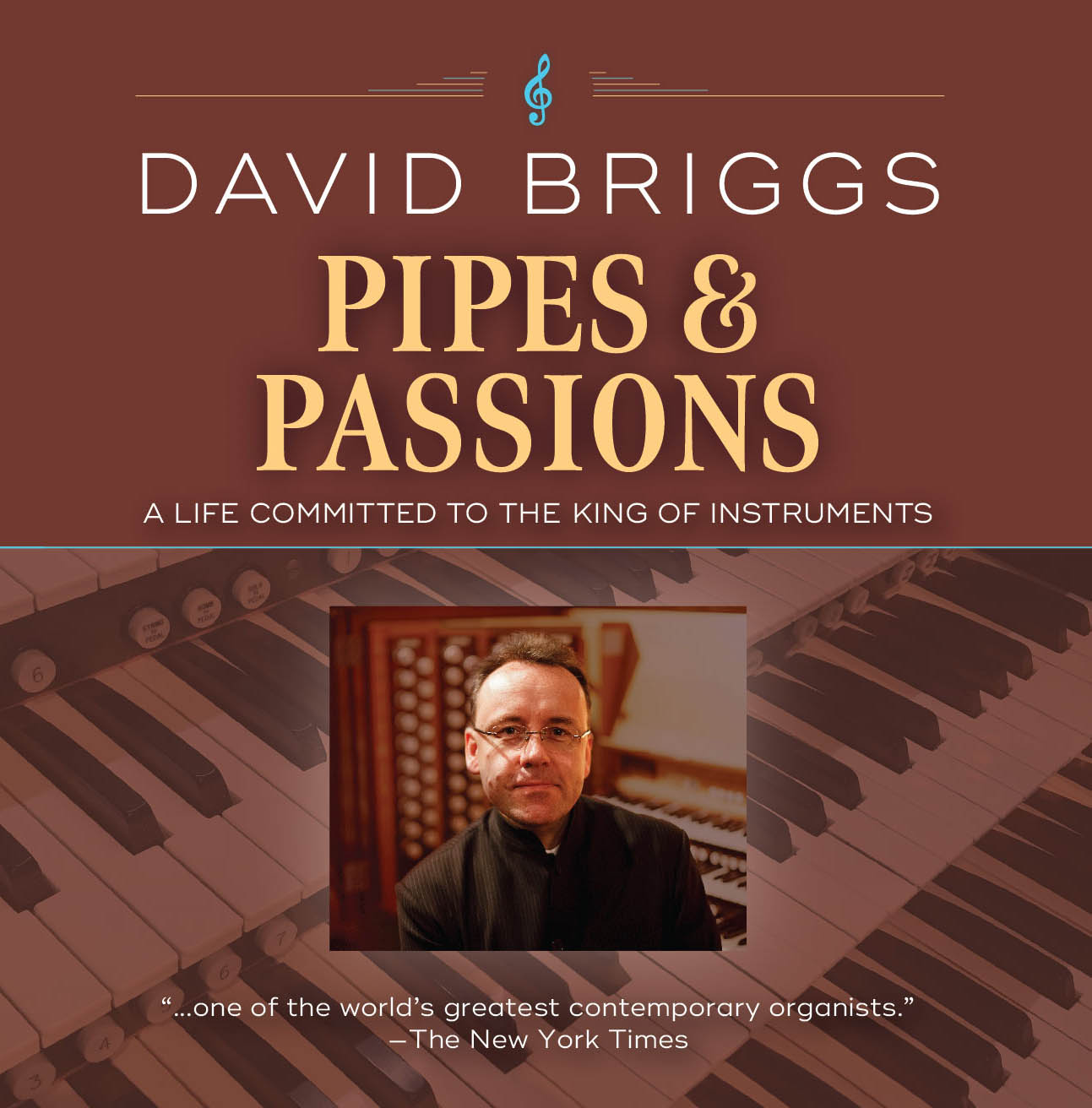
PIPES & PASSIONS
David Briggs
Chestnut Music (www.david-briggs.org)
136pp. PB £22.20
Several autobiographies of eminent figures in the organ music world have been published recently. Most have been written at the end of a career, but here we have a younger, but no less eminent organist, taking stock of his experiences, sub-titled ‘A Life Committed to the King of Instruments’.
Each of the 38 chapters is a short story on a specific topic, ranging from the author allegedly singing Widor’s ‘Toccata’ as an infant in a supermarket shopping trolley, through chorister at Birmingham Cathedral, organ scholar at King’s College, Cambridge, cathedral posts and into his freelance career as concert artist, composer and improviser.
Although one can read through the whole book as a continuous narrative, each chapter is a life snapshot which can be dipped into at random, revealing such lesser-known facts as the author’s prowess on the viola and his time in the National Youth Orchestra. To mention that this reviewer finished the book on the day he received it does not imply a paucity of content, but rather that it was an engaging read. I have only one minor criticism, which is that the reproduction of the many and varied photographs is not quite up to 21st-century standards.
I sincerely hope that after further decades another instalment of ‘A Life Committed to the King of Instruments’ might be forthcoming.
John Henderson

CHORAL MUSIC
E Easy
M Medium
D Difficult
UPPER-VOICE CAROLS
HOW FAR IS IT TO BETHLEHEM? [E]
arr. Kerry Boyle
SSA and piano
Encore Publications 020781 £2.25
HOW BEAUTIFUL [E/M]
Richard Peat
Two-part upper voices and organ
Encore Publications 020782 £2.25
Kerry Boyle writes sympathetically for voices with naturally flowing lines. The English traditional melody for How far is it to Bethlehem? is arranged in what appear to be three vocal parts but mostly voice 1 doubles 2 or 2 doubles 3. The piano part is of interest in itself but also supports the singers. Unusually, the key drops a fourth for the final verse; the ending is quiet with a repeated ‘sleep’.
Richard Peat sets just the first verse of John Mason’s ‘How beautiful are the feet that bring’, with a melody that has the feel of a slow triple-time carol, although the sustained organ part (soft throughout) keeps the texture rooted – especially the repeated pedal part of just four notes, one every two bars. It is an unusual setting, intense and introverted, apart from an unexpected vocal outburst on ‘the true Bethlehem’.
SING OUT, ANGELS! [E]
Alan Bullard
Two-part upper voices and keyboard
GIA Publications G-10544 $2.70
STAR CAROL [E]
John Rutter
SSA and piano
Oxford W273 £2.95
Sing out, angels is shown as being for unison voices and keyboard, but I am sure that anyone hearing it with the optional ‘descant’ line will thereafter consider it a two-part piece. The extra line is a descant (to ‘Ah’) only in the third verse. In the following final verse it becomes an independent line imitating the tune and intensifying the music. The first three verses are notable for a switch from A flat to C major for the ‘Sing out, angels!’ chorus, replaced in the last verse by E flat major and a forceful climax. An SATB and keyboard version is also available, G-10543, at the same price.
Star Carol has been available for SATB since the early 1970s, as well as in a shortened unison arrangement; Sir John Rutter has now produced, in his 80th birthday year, an SSA scoring that is sure to be welcomed by upper-voice choirs. The piano part is compatible with the keyboard and orchestral accompaniments of the original SATB version. 
CHRISTMAS SUITE [M]
Emma Johnson
SSA and clarinet
Encore Publications 020777 £6.95
(clarinet part 020778 £2.95)
Emma Johnson’s Songs of Celebration, also a Christmas suite for upper voices and clarinet, and reviewed in SbyS, September 2021, contained four original Christmas compositions. By contrast, here, under the title Christmas Suite, are three pieces based on well-known melodies. Carol of the Bells transforms the Ukrainian carol with new words by Emma Johnson and culminating in wild and joyful peals of bells. In the Coventry Carol, the choir keeps to a straightforward version of the music while the clarinet wails more like a Middle Eastern wind instrument, lamenting the massacre of the innocents. Silent night is serene, with imaginative choir textures and a flowing, rocking clarinet part – an atmospheric arrangement.
LONG, LONG AGO [E]
Sarah Quartel
SSA and piano
Oxford W271 £2.95
Canadian Sarah Quartel has set the words of the children’s hymn ‘Winds through the olive trees’, the verses of which end ‘long, long ago’. She evokes the olive trees, sheep and shepherds with a gentle pastorale. The accompaniment conjures up softly blowing winds and dancing pipes; voices tell of the joyful song of the angels – starting in unison, then in two parts, then three parts homophonically and finally with imitation. It is a charming picture in music and words of a countryside scene, ‘long, long ago’. An SATB and piano version is also available, X931, at the same price.
Stephen Patterson
SATB CAROLS
HODIE CHRISTUS NATUS EST [M]
Tamsin Jones
SATB and optional organ
Encore Publications 020776 £2.75
MARIA DURCH EIN’ DORNWALD GING [E]
arr. David Lawson
SATBarB
Encore Publications 020783 £2.25
Tamsin Jones weaves together thrilling syncopations, modal cadences, plenty of open fifths, and pitches generated by a procedure (soggetto cavato) found in the 15th century where the vowels of the text are matched with sol-fa syllables. The tempo indication at the start is ‘excitedly’, which is a fair description until the end, when we approach the crib in what feels like awe and reverence. The organ part is optional but might be desirable to reinforce some long bass pedals.
David Lawson has made a charming arrangement of a familiar German folk carol in which roses bloom when Mary carries Jesus through the previously barren thorn-wood. A solo baritone is accompanied by five-part choir in verse 1, and solo soprano by the choir in verse 2. Verse 3 is for choir alone but starting in unison where previously a solo voice sang. Harmonies return for the climax of the setting as the roses appear; the five-part choral texture provides extra richness in the quiet conclusion.
SOMEHOW NOT ONLY FOR CHRISTMAS [E]
Bob Chilcott
SATB and piano
Oxford BC279 £2.95
ALLELUIA! A NEW WORK IS COME ON HAND [D]
Bob Chilcott
SATB and organ
Oxford BC277 £3.95
Somehow not only for Christmas, a setting of a poem by John Greenleaf Whittier (of ‘Dear Lord and Father of mankind’ fame), is a carol setting that is warmly nostalgic without (quite) becoming sentimental. A sonorous piano part supports easy vocal lines that urge us to give joy to others ‘not only for Christmas’ but throughout the year.
Alleluia! A new work is come on hand is also by Bob Chilcott, but utterly different. The text, from an early 15th-century carol, has been set by many composers in the 20th century and more recently. Chilcott’s approach is vivacious and with hypnotic repetitions of ‘Alleluia!’ at the end of each verse. A transformation into a gentler mood (but with no slackening of the tempo) starts the final verse with ‘this sweetè song’, before a build up into three pages of Alleluias. It was commissioned by the choir of Norwich Cathedral; you can enjoy them singing it on a YouTube clip from their latest carol CD.
CHRISTMAS CHILD [E]
John Rutter
SATB and organ
Oxford X942 £2.95
LOVE CAME DOWN AT CHRISTMAS [E/M]
Christopher Maxim
SATB and organ
Paraclete Press PPM02183M $2.20
Christmas Child was commissioned by Yale Institute of Sacred Music in honour of David Hill, and first performed last year by The Bach Choir at the Royal Philharmonic Orchestra’s ‘Christmas Celebration with John Rutter’ at the Royal Albert Hall – a star-studded premiere! Nevertheless, the piece is equally a gift for small church choirs and easy to learn. The tune is catchy, with a neat sidestep up a minor third after just four bars, followed by a refrain in the subdominant that reaches its climax via a 10-note rising scale. John Rutter retains his ability, seemingly effortlessly, to provide charm and a feeling of well-being for the Christmas season.
Christopher Maxim has written a big, arching melody for Love came down at Christmas (with words by Christina Rossetti). The music fits the words particularly well, highlighting important syllables and flowing with the shape of the poem. The organ part adds colour as well as support for the singers.
IN THE BLEAK MID-WINTER [M/D]
David Stevens
SATB and organ
Encore Publications 020816 £2.25
IN THE BLEAK MID-WINTER [M]
Philip Moore
SATB (with optional solos) and organ
Encore Publications 020822 £2.75
David Stevens has made a concise setting of Christina Rossetti’s poem, omitting the ‘Enough for him’ verse. A triple-time metre marked ‘gently moving’ is constant for the first three descriptive verses but then changes into quadruple time for the personal ‘What can I give him’. Six flats in the key signature make it look at first glance like a Rutter anthem, but Stevens’s lines are more angular. The organ accompanies the first and third verses for sopranos and tenors respectively, without ever doubling the voices. Verses 2 and 4 are for four-part choir, unaccompanied – apart from at the end, when the organ enters for the final three bars after leaving the voices unaccompanied for 22 bars: there is a challenge for the choir’s intonation.
Philip Moore’s setting is almost a little five-minute cantata with three solo verses and two choral ones, although the verses may be sung solo or full in unison. Sopranos open with a scene-setting first verse and an accompaniment marked ‘cold and remote’. The second, for unaccompanied choir, is more dramatic. The third is warmer and for male voice or all men. The fourth has sopranos solo or tutti describing the heavenly beings thronging the air and then, more tenderly, the mother’s kiss. The final verse uses, for the first time, four-part choir with organ.
Anyone who has sung the Holst setting knows how the syllabic stresses vary within each verse. Philip Moore captures this fluidity with constantly changing time signatures, allowing the drama and the beauty of the words space to express themselves.
James L. Montgomery
SIR CHRISTÈMAS [D]
arr. Joy Williams
SATB with divisions
Encore Publications 020811 £2.75
WE THREE KINGS [M]
arr. David Stevens
SATB and organ
Encore Publications 020817 £2.75
Joy Williams’s arrangement of Sir Christèmas is rhythmically tricky. In the interest of precision and clarity, I imagine it working best with a small choir, but all voices divide, and sopranos into three parts, so not too small! The words and tune are the well-known 15th-century ones, but the texture is dominated by off-beat Nowells that are exciting for choirs that can sing them accurately and sounding as if without effort.
Over the years, there have been many unexpected variations on We three kings, from Miles Davis to Sufjan Stevens (no relation to the arranger of this version). Here, perhaps we should realize that all is not going to be as expected from the uneven rhythm of David Stevens’s 2-bar introduction. However, the voices start off as though nothing is amiss, until the ‘star of wonder’ chorus for verse two suddenly breaks into 5/8. After that, little seems to goes to plan. Molto marcato sopranos and altos are followed by quasi plainsong tenors and basses, after which the whole choir forgets to move to the relative major for the chorus. No matter, as everything is about to move up a semitone for the final verse, followed by a reprise of the 5/8 version of the refrain. It is tremendous fun, and not too difficult.
Julian Elloway
THREE-PART SA/MEN CAROLS
A CHRISTMAS ROSSETTI SEQUENCE [E]
Tim Knight
SAB and piano
Tim Knight Music TKM905 £2.55
The first of the three carols in this sequence, Christmas has a darkness, has a jolly swagger, enjoyed in turn by all three parts above decorative piano figuration that I imagine is the heavenly ‘music for all angels soon to sing’. Any setting of In the bleak mid-winter has to be judged against serious competition, but Tim Knight has crafted a melody that stands up to repetition over five verses with plenty of variety in vocal scoring and accompaniment. After that central carol, the final Love came down at Christmas, in the same key and perhaps at a similar speed (although no tempo indication is given), seems a little lightweight.
INFANT HOLY [E]
arr. Alan Bullard
SABar and keyboard
GIA Publications G-11153 $2.35
PATAPAN [E]
O LITTLE ONE SWEET [E]
arr. Alan Bullard
SABar and keyboard
Colne Edition CE139; CE140 £2.50 each
Smaller choirs wanting to sing carol arrangements with only a single T/B line will find much reward in these three separate arrangements. Infant holy has a similar gentle simplicity to the Willcocks SATB version, although instead of a two-bar pedal in the bass, here the piano sustains the bass note through eight bars. The piano part in Patapan imitates a fife and drum, above which the choir enjoys a sort of vocal folk dance. A more serious start to the final verse, welcoming Jesus’ birth, turns into a gallop to the end. O little one sweet has a melody that, after 28 dreamily flowing bars, proves to be a countermelody to the German traditional chorale tune associated with these words.
Alan Bullard is a skilful and thoughtful composer who takes care over every detail in these arrangements, never exposes his singers or asks for more than they can give, yet does not appear to be simplifying or constraining his imagination. Audiences as well as singers will appreciate performances of these pieces.
Julian Elloway
ORGAN MUSIC
E Easy
M Medium
D Difficult
SIMPLIFIED HYMNS
SIMPLY ORGANISED [E]
arr. Robert Gower
Banks Music Publications 14158 £15.00
Many so-called reluctant organists once benefited from Janette Cooper’s long out-of-print Hymn tunes for the reluctant organist. Here is an excellent collection of 58 three-part arrangements for manuals only, which should help beginner organists to play hymns confidently. The choice is wide-ranging: mostly it covers standard hymnody, but there are also Marty Haugen’s Gather us in, Leonard Smith’s Our God reigns and Graham Kendrick’s The Servant King as well as Shine, Jesus, shine – these are particularly valuable, being more difficult to play on the organ using the piano accompaniments with which they were first published.
The music layout is clear and spacious, and wire-o binding enables the volume to lie open easily. The preface briefly covers the importance of a regular pulse and also discusses registration. If this well-chosen volume encourages more churches to use their organs and congregations to sing with confidence, rather than going over to pre-recorded hymn accompaniments, it will have fulfilled a valuable task.
Duncan Watkins
VOLUNTARIES
SUITE DU CINQUIÈME TON [M]
Denis Bédard
Éditions Cheldar (RSCM) CH98 £7.50
Six short movements have titles that suggest the registrations of a French Baroque organ suite, but the music is in no way a pastiche. The opening ‘Plein Jeu’ has an arresting grandeur, followed by a playful ‘Basse de Trompette’ where the left hand has a decidedly jolly trumpet tune. It is one of two movements that do not use pedals at all. ‘Récit de Cornet’ has a wistful triple-time melody, while ‘Écho’ alternates between a loud reed and quiet flutes.
As with all the movements, ‘Dialogue sur la Voix humaine’ is headed with suggested registrations; here pedals enter for the final 13 bars, taking over the slow tune and giving a feeling of gravitas to the conclusion. The final ‘Grand Jeu’ is more difficult than the other movements, but there is no need for this suite always to be performed in its entirety. It is also an attractive collection of characterful individual voluntaries for use before and after services.
Duncan Watkins
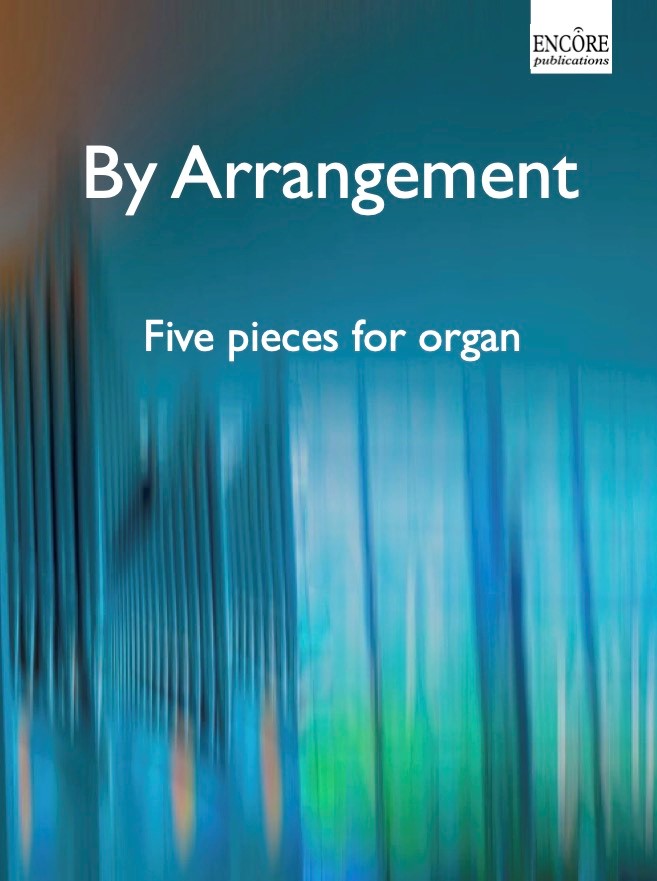
BY ARRANGEMENT [E–M]
compiled by Timothy Rogers
Encore Music Publications 010044 £14.95
Here are five varied voluntaries, four of them based on hymn tunes. The other is Simon Lole’s Meditation on ‘Annie Laurie’, a tune that I doubt has ever been used for a hymn. The volume opens powerfully with Esther Bersweden’s Interlude on ‘Aus der Tiefe’ (Heinlein), where the melody sounds very slowly in the pedals – less an interlude than what feels like a dramatic response to the words of ‘Forty days and forty nights’. By contrast, sunshine appears in Richard Elfyn Jones’s Postlude on ‘Blaenwern’, especially when the music moves from G to A major and the melody (previously within the texture) appears for the first time on top of the harmonies. Bryan Kelly’s Prelude on ‘Rockingham’ is short and straightforward – and all the more effective for that. ‘Rocking’ (was that deliberate?) pairs of quavers gently decorate the two statements of the melody within a largely two-part texture.
Sarah MacDonald’s Toccatina on ‘Slane’ is different in feel from the other pieces. The melody, marked ‘delicately’, is picked out at the start and finish on 4ft Flutes, with more lyrical and colourful sections in between. None of these pieces is a fill-in for an organist before or after a particular hymn; instead, all are excellent, self-contained voluntaries that would enhance services at different times of the year (and perhaps even Annie Laurie for St Andrew’s Day).
Julian Elloway