

*Worth hearing
**Recommended
***Essential listening
CHORAL CDs
***
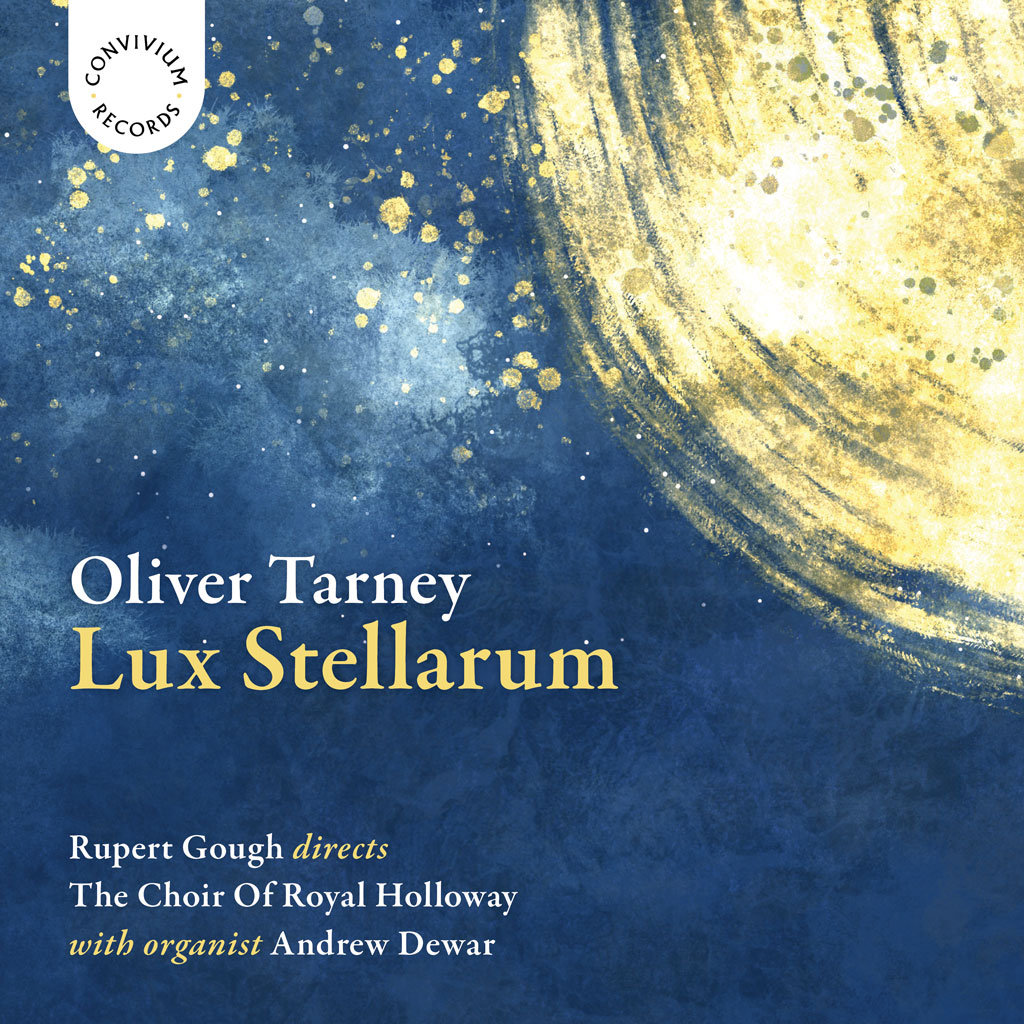
OLIVER TARNEY: LUX STELLARUM
Choir of Royal Holloway / Andrew Dewar (organ) / Rupert Gough ♦ Convivium Records CR111
Lux Stellarum (‘Light of the Stars’) is a short requiem. The CD plays for less than 30 minutes, but much is packed into that duration and one does not feel shortchanged. Each of the five ‘standard’ movements (Requiem aeternam, Kyrie, Sanctus, Agnus Dei and In Paradisum) include additional Biblical and liturgical texts. An extra movement (number 3 in the sequence) sets a poem by the Canadian Marjorie Pickthall that contemplates ‘the stars which sang when earth was made’, and parallels a later insertion into the Agnus Dei of John Donne’s ‘one equal music … one equal eternity’ prayer. Outside such times of repose, there is much drama, such as in the Sanctus that builds to a huge climax and also, at the end of the In Paradisum, a final organ outburst to conclude the whole work.
The music is eclectic in a variety of styles and textures, and includes plainsong from the Requiem Mass and also appropriately Conditor alme siderum (‘Creator of the stars of night’) in a way that reminds one of Duruflé, also an influence along with other 20th-century church composers. It is not so much a liturgical Requiem as a devotional work that incorporates the Requiem text into a contemplation on the mystery of the cosmos. Rupert Gough, his excellent student choir, and Andrew Dewar’s mastery of the Tickell/Ruffatti organ in the acoustic of Keble College Chapel are all captured in a first-class recording.
**
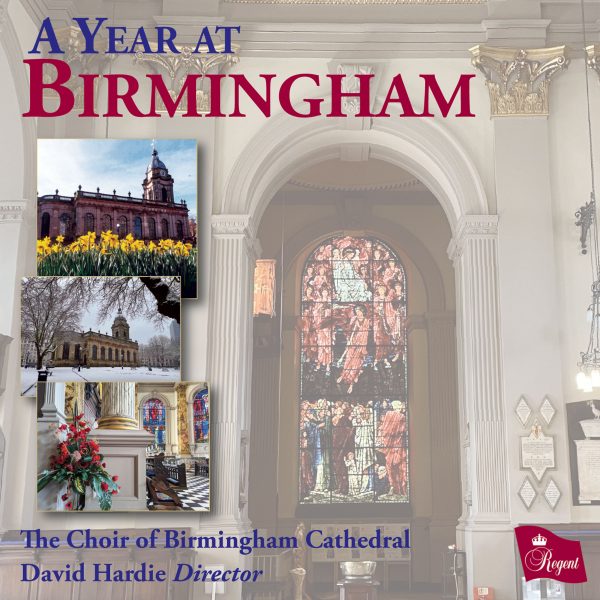
A YEAR AT BIRMINGHAM
Choir of Birmingham Cathedral / Ashley Wagner (organ) / David Hardie ♦ Regent Records REGCD590
Regent’s long-established ‘A year at …’ series provides a valuable documentation of (mostly) British cathedrals and the variety of their repertoire and performance styles. This CD from the Cathedral Church of St Philip in Birmingham is the first recording with David Hardie as the cathedral’s head of music and displays sensitive and well-disciplined singing, captured clearly in the acoustic of the comparatively small building.
The repertoire celebrates the cultural and demographic diversity of Birmingham found within the city and reflected in the cathedral’s choirs, along with a special mission to support the vulnerable and marginalised. The anticipated journey from Advent through to Christ the King takes in pieces by Mitchell B. Southall (In silent night with words by the composer), Florence Price (Resignation, with words in the first person by an African American slave), Ben Ponniah, Judith Bingham (Corpus Christi Carol) and James MacMillan – his A Child’s Prayer in response to the Dunblane Primary School shooting and sung in Birmingham for ‘Safeguarding Sunday’). At the centre of the journey through the year come Passiontide (Ireland’s Ex ore innocentium), Easter (Stanford’s Ye choirs of new Jerusalem), Pentecost (Harris’s Come down, O Love divine) and Trinity (Wood’s Great Lord of Lords) showing how the choir also excels in the classic works of the cathedral repertoire. That choral sequence is interrupted by Ascension and a solo organ Offertoire pour la fête de l'Ascension by Théodore Dubois, played with exciting registrations by David Hardie. Elsewhere the skilled organist is Ashley Wagner, notable for his contribution to Mathias’s Let the people praise thee, O God.
**
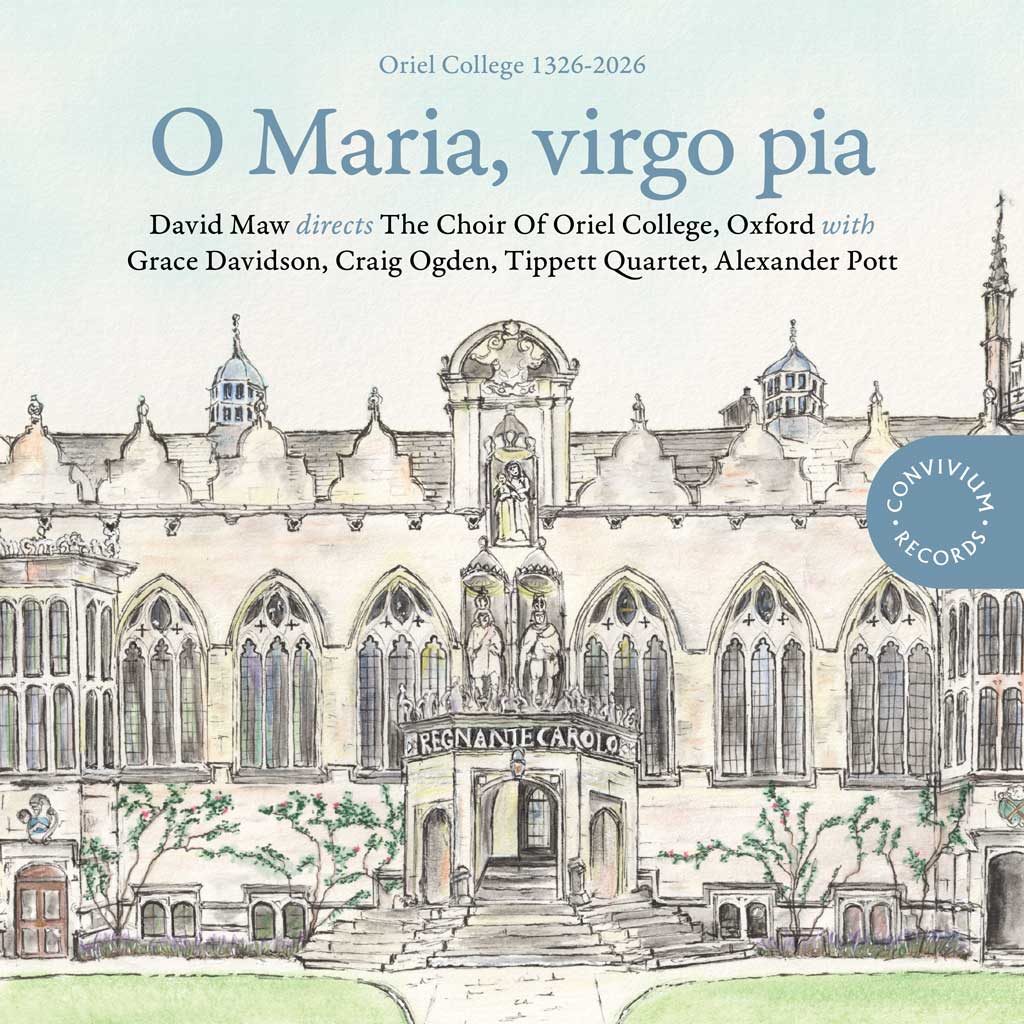
O MARIA, VIRGO PIA
Choir of Oriel College, Oxford / Grace Davidson (soprano) / Craig Ogden (guitar) / Tippett Quartet / Alexander Pott (organ) / David Maw ♦ Convivium Records CR117
Not often is a 700th anniversary celebrated on disc, but Oriel College, Oxford was founded in 1326 and this CD contains music that spans those centuries, all with an Oriel connection. Its 14th-century dedication as ‘the House of the Blessed Virgin Mary in Oxford’ is reflected in the first track, the 13th-century O Maria, virgo pia, whose chant is found in Judith Bingham’s Oriel Service that follows, and also in the final piece, a setting by Cheryl Francis-Hoad of the same words. Settings by David Maw of ‘I sing of a maiden’ and of the Magnificat continue the Marian theme.
Another strand is the Phos hilaron, translated by Oriel fellow John Keble as ‘Hail, gladdening light’ and set by David Briggs and by John Caldwell. Oriel was at the centre of the Oxford Movement and John Henry Newman, college chaplain 1822–30, is represented with a setting by James Whitbourn of his poem Solitude (for choir and guitar and featuring Craig Ogden in a piece of ‘luxury casting’), and by a surprising four-movement cantata, Hymn of the Third Choir of Angelicals. This takes verses from The Dream of Gerontius, including ‘Praise to the holiest’, and was composed and submitted by Edmund Fellowes (of Tudor Church Music fame) for his BMus degree. There is a long solo for Grace Davidson who is outstanding here and in a complex solo part in Maw’s Magnificat. The home team includes the excellent Alexander Pott on organ; David Maw has assembled an enterprising programme and is rewarded by bright and committed singing. Fellowes wrote in his autobiography that when he was a student ‘Oriel was in no sense a musical college.’ How things have changed!
**
MATTHEW COLERIDGE: THE BREATH OF LIFE
Choir of Royal Holloway / Southern Sinfonia / Lionel Handy, Maxim Calver (cello) / Simon Earl (organ) / Rupert Gough ♦ Convivium Records CR116
Ian Munro described Matthew Coleridge’s Requiem in CMQ (June 2023) as ‘hauntingly beautiful’. The Breath of Life contains much beauty (the opening of ‘These Great Trees Are Prayers’ for instance), but Coleridge explains that he ‘wanted to write something full of life and positivity, something that would scream joy, vitality and rhythm – quite the opposite of a Requiem.’ The word ‘Hallelujah’ is prominent in the earlier movements of a work that moves from joyful praise to a contemplation of nature and creation.
The texts of the eight movements include psalms, the Benedicite, Rig Veda, Christopher Smart, Nikos Kazantzakis, Rabindranath Tagore, Kahlil Gibran and more, while the fifth movement is a sequence of verses by five different Christian hymn writers. This central movement, originally written as a separate anthem, lies at the heart of the work and moves from Bishop Ken’s ‘Praise God, from whom all blessings flow’ through William Draper and Isaac Watts to a climax with Althelstan Riley’s ‘All saints triumphant raise the song’, before relaxing into a Charles Coffin doxology, all with multiple Hallelujahs. Rhythmic drive is found in a playful setting of the Benedicite and a terrifying ‘For Thunder is the voice of God’, one of several verses taken from Christopher Smart’s Jubilate Agno. Rupert Gough directs a vibrant-sounding choir of Royal Holloway in this cantata for choir and small orchestra, and also in Coleridge’s three Requiem Motets for eight-part choir and solo cello, and in three Songs of Light: all slow pieces that develop the ‘hauntingly beautiful’ atmosphere of the previously reviewed Requiem.
Judith Markwith
*
MOZART: REQUIEM; FAZIL SAY: MOZART MEVLANA
Fatma Said (soprano), Marianne Crebassa (mezzo-soprano), Pene Pati (tenor), Alexandros Stavrakakis (bass), Berlin Radio Chorus, Luzerner Sinfonieorchester, Michael Sanderling ♦ Warner Classics 5021732754721
Mozart’s Requiem, with the standard Süssmayr completion, receives an exciting modern-instrument performance. Tempi tend to be driven forward with urgency; the Berlin Radio Chorus is particularly impressive in the fast runs. The combination of soloists from Egypt, France, Samoa and Greece is a sign of the fusion found in this CD – in particular in the second piece, a setting by pianist and composer Fazil Say of words by the Sufi poet Mevlana Rumi, using the same scoring as Mozart plus a Turkish flute and drums. Say explains his intention to ‘unite East and West in love and friendship through texts from the great philosopher Mevlana and quotations from the music of a composer of genius like Mozart … Mozart’s music is the music of humanity. Likewise, Mevlana’s words unite people regardless of their religion’. The music is tonal and with clear references to Mozart, but with Turkish metres and harmonies, and coloured by (among other devices) drum ostinatos, string glissandi and snarling brass. Adventurous listeners will enjoy this intended bridge between East and West, concluding in an almost mystical final quartet.
Julian Elloway
ORLANDO GIBBONS CD
***
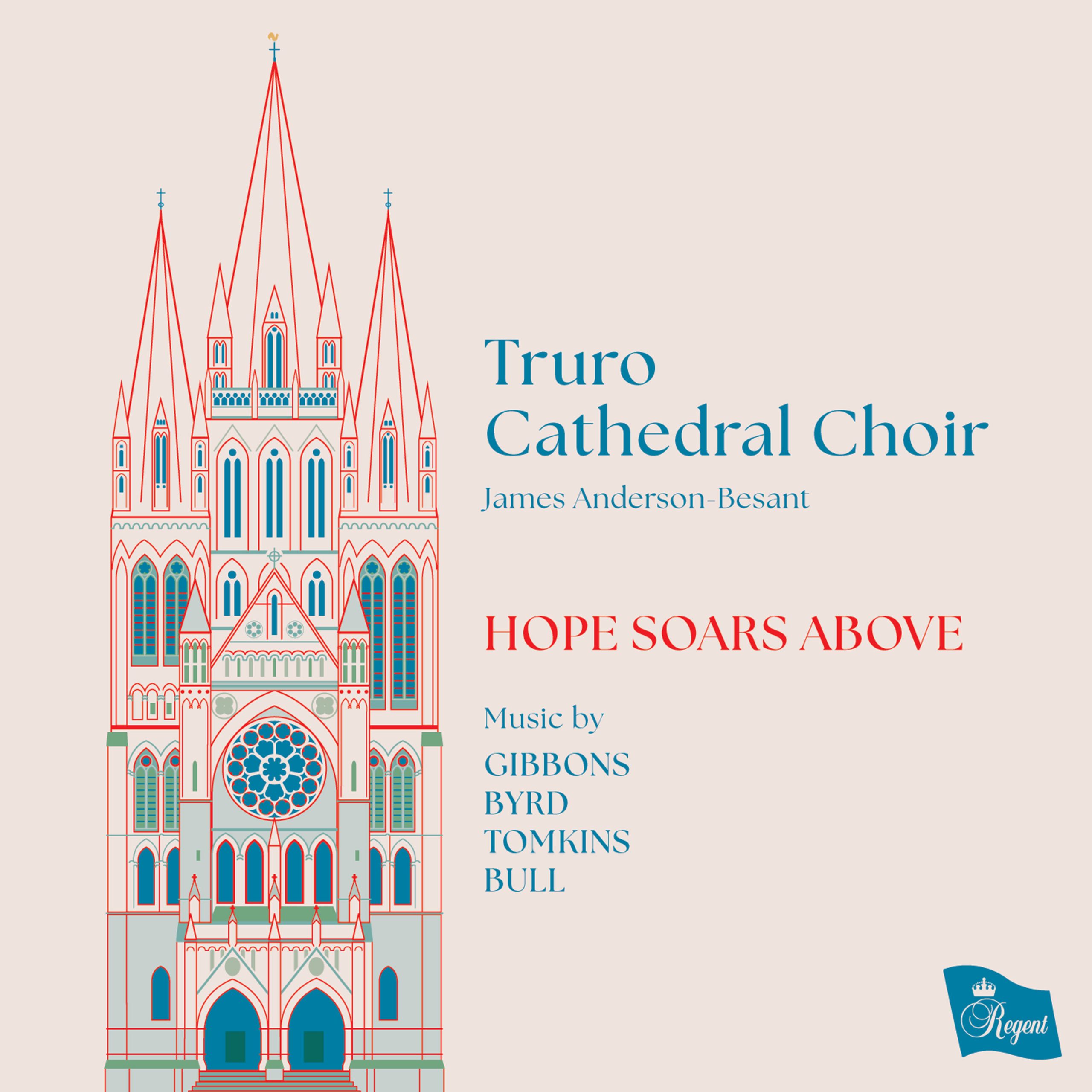
HOPE SOARS ABOVE
Truro Cathedral Choir / Andrew Wyatt, Jeremy Watt (organ) / James Anderson-Besant ♦ Regent REGCD599
The 400th anniversary of the death of Orlando Gibbons (1583–1625) last year was marked by recordings of which this is one of the most interesting, juxtaposing sacred choral and solo organ works by Gibbons himself with those by his contemporaries William Byrd, John Bull and Thomas Tomkins. The organist stylishly accompanying the anthems and services is Andrew Wyatt, who is joined by Jeremy Watt and James Anderson-Besant for three solo organ works, two of which are played in St Mary's Aisle of the cathedral on its 1750 John Byfield organ.
The singing has a freshness that cuts through the acoustic with clarity, and with phrases sensitively shaped. The programme is built round the Gibbons Short and Second Services, but the larger anthems also leave a strong impression, such as Tomkins’s Almighty God, the fountain of all wisdom, Gibbons’s O thou, the central orb, and above all Byrd’s Sing joyfully that receives as polished and joyful a performance as I can remember hearing. In this emotional roller coaster of a CD, it provides an antidote to the mournful Out of the deep by Gibbons and to the organ Sad Pavan for these distracted times by Tomkins.
Stephen Patterson
ORGAN CD
***
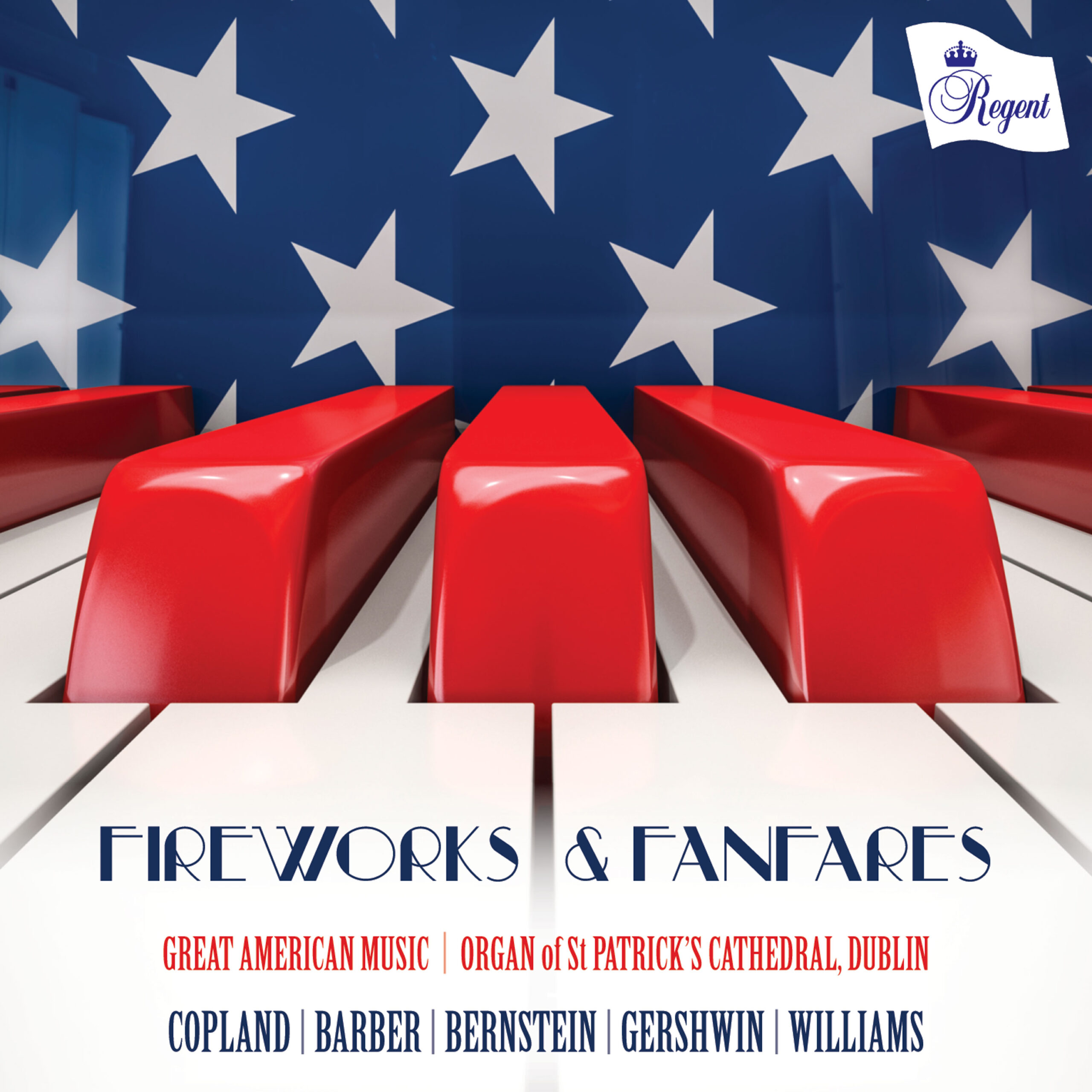
FIREWORKS AND FANFARES: GREAT AMERICAN MUSIC
Stuart Nicholson and Harry Meehan play the organ of St Patrick’s Cathedral, Dublin, with Victoria Green (saxophone/flute) / Áine Balfe (flute/piccolo) / Richard O’Donnell, Bernard Rielly, Dylan Quinn (percussion) ♦ Regent REGCD600
Listening to this CD is huge fun. Stuart Nicholson is the organist throughout, joined by Harry Meehan in five tracks of organ duet arrangements: Bernstein’s Overture to Candide, Sousa’s The Stars and Stripes forever, Henry Mancini’s ‘Baby Elephant Walk’ from Hatari (with piccolo, flute and saxophone) followed by Ghostbusters and music from Independence Day (with three percussionists). The disc opens with Copland’s Fanfare for the Common Man (organ and percussion) and includes gentler items such as Barber’s Adagio for strings, Virgil Fox’s arrangement of Simple Gifts and an arrangement by Fox’s assistant, Robert Hebble, titled Homage to Fritz Kreisler: Londonderry Air. But it is the show-stoppers that leave the strongest impression, not least the finale of an over-the-top arrangement by Paul Ayres: Fantasy-Sonata ‘Over the rainbow’ played spectacularly by Stuart Nicholson. Henry Willis might have been surprised at the repertoire, but his 125-year-old instrument takes it all in its stride. This is one of the most enjoyable organ CDs that I have heard for a long time.
Julian Elloway

CHORAL MUSIC
E Easy
M Medium
D Difficult
EVENSONG CANTICLES
SAN DIEGO SERVICE [E/M]
Joanna Forbes L’Estrange
SATB and organ
RSCM Publications RES175 £3.50;
MAIDA VALE SERVICE [M]
Ben Ponniah
SATB with divisions and organ
RSCM Publications RES173 £3.95
ST MARTIN’S SERVICE [M]
Lucy Walker
SATB and organ
RSCM Publications RES 172 £4.50
All three pieces take as their starting point that the Magnificat is the Song of Mary. In her San Diego Service, Joanna Forbes L’Estrange opens with a light soprano solo ‘with childlike innocence’ and a melody that will recur for both Glorias and in particular ‘as it was in the beginning’. The opening has an organ accompaniment in which Stanford meets Rutter to delightful effect. Particularly effective is the repetition of particular words and musical motifs to form an accompaniment with ‘blessed’ repeated eight times as an accompanying pattern and ‘mercy’ 11 times.
The tempo relaxes a little for the central section starting ‘He hath put down the mighty from their seat’, with a new melody that will reappear at the start of the Nunc Dimittis. Where the Magnificat ends with a triumphant Amen, the Nunc Dimittis allows a more contemplative feeling as if Simeon is allowed to depart in peace. The setting is carefully conceived with attention to verbal and musical detail – it is also written with an understanding of voices, vocal ranges and breath control. The organ provides support throughout. Parish choirs will find this an easy to perform and rewarding addition to the repertoire.
Ben Ponniah, in his Maida Vale Service, allows all sopranos to sing the first two sentences, after which altos join and then upper voices split into four parts for ‘he that is mighty’. Tenors and basses enter dramatically at ‘He hath shewed strength’. A unison ‘He hath put down’ is appropriately terrifying, followed by a sweet ‘exalted the humble and meek’. The opening Magnificat melody reappears as if reassuringly for ‘He remembering his mercy’. In the Nunc Dimittis, a solo tenor opens as the voice of Simeon. Both Glorias share the same material and end powerfully with some jazz influenced, ‘scrunchy’ chords.
Lucy Walker is more flexible in metre as she captures the natural flow of the text in her St Martin’s Service. Despite the changes in time signature, it is the setting that sounds most within the Anglican tradition in its harmonic language and textures. There is a warmth in the writing, whether in the hushed final verses of each canticle, or with the subsequent blaze of light at the start of each Gloria, announced by a short organ crescendo. But where the first Gloria discards the previous D major to grasp a bright F sharp major, the Gloria at the end of the Nunc Dimittis remains in D major, staying at home, so to speak, and finishes at rest; it gives, in the composer’s words, ‘an expression of homecoming and comfort’.
SAINT PAUL’S SERVICE [E/M]
Malcolm Archer
SATB and organ
Encore Publications 020843 £2.95
PRECES AND RESPONSES, SET 3 [E/M]
Malcolm Archer
SATB
Encore Publications 020841 £2.75
The service setting and the responses were commissioned by St Paul’s church in Augusta, Georgia, hence the title. It is a tuneful setting, right from the start when sopranos duet with an organ Solo Flute. The organ has a perky little one-bar motif, which sopranos answer by more or less repeating the second part of the phrase at half speed. This idea dominates the Magnificat, used flexibly to illustrate the text. As with Ben Ponniah’s setting reviewed above, sopranos have the first two sentences, altos join them from ‘For behold’ and full choir from ‘He hath shewed strength’. At the start of the Nunc Dimittis, tenors and basses sing the words of Simeon. The organ is silent for the choir to sing forte ‘To be a light’, rejoining for a fortissimo ‘and to be the glory’. A reflective statement of the ‘Magnificat motif’ prepares the way for a resolute restatement of the Gloria.
The Preces and Responses, in the same key as the St Paul’s Service, include a full setting of the Lord’s Prayer. Both these publications demonstrate skill in writing effective music within the range of most church choirs – but rather than simply admiring the musical invention, the listener is carried along in a sweep of joyful melody.
James L. Montgomery
CHORAL WORKS
REQUIEM [M/D]
Grayston Ives
Tenor solo, SATB and chamber orchestra
Carus-Verlag vocal score 27.325/03 €24.00
It has been a long time since the first performance of this Requiem in 2008 to mark the 550th anniversary of the foundation of Magdalen College, Oxford. A CD recorded by the choir of Jesus College, Cambridge appeared on Signum Classics in 2021, and now we have orchestral score, vocal score and chorus score handsomely produced by Carus Verlag in Germany, with the vocal score supplied for review including a piano reduction of the chamber orchestral accompaniment. Organists are well used to making their own organ versions of piano accompaniments. However, for the American premiere in 2013, apparently an organ reduction by the composer was used that would certainly be useful for liturgical performance.
Bell sounds are much in evidence, with tiny Tibetan hand-held cymbals at the beginning and end, and an a cappella Benedictus in which the chorus imitates a choir of handbell ringers, ending with ‘in ex-cel-sis’ repeated as if pealing off into the distance – a striking effect. With such an experienced choir director as composer, it is no surprise that the vocal writing flows naturally, whether in plainchant-like passages that are passed from voice to voice or in more violent, rhythmically exciting writing such as the Sanctus or the central part of the final Libera me. The concluding In Paradisum has a gently rocking accompaniment over which the choir floats celestially before the high bells announce the conclusion.
Julian Elloway
CREDO: SIX COMPOSERS – SIX PARTS – ONE CHRISTIAN FAITH
Martín Palmeri, Marten Jansson, Keiko Harada, Dominick DiOrio, Victoria Vita Poleva, Grayston Ives
>SATB with divisions
Carus-Verlag 7.461/00 €14.40
The year 2025 marked the 1700th anniversary of the Council of Nicaea in 325, at which the fundamental definitions of Christianity were debated and, in particular, what we now call the Nicene Creed was agreed. To celebrate this, and developing from its three-in-one unity, this setting of the creed was commissioned from six different composers from six different counties and representing six different strands of Christianity: unity, diversity and solidarity.
Mårten Jansson (Sweden) opens with ‘Credo in unum Deum’ and what appears to be a dense eight-part setting of the opening clauses of the creed, although there is much doubling within the eight parts. Emphasis is placed on the word ‘Credo’ and there are big crescendos, including one from triple piano to triple forte. Keiko Harada (Japan) takes over at ‘Et incarnatus est’. Syllables are separately formed and linked as if becoming incarnate, and dissolve into nothing at the mystery of ‘homo factus est’. Grayston Ives (United Kingdom) contributes a pained and solemn ‘Crucifixus’. Victoria Vita Poleva (Ukraine) offers an unexpectedly restrained, almost ritualistic ‘Et resurrexit’ contrasting with Martin Palmeri (Argentinia) who introduces some syncopations and also reiterates ‘Credo in unum Deum’ for structural effect. It is left to Dominick DiOrio (USA) to bring the work to a vigorous conclusion with excited, vigorous Amens.
Stephen Patterson
ORGAN MUSIC
E Easy
M Medium
D Difficult
BUXTEHUDE COMPLETE ORGAN WORKS
ORGAN CHORALES
Dieterich Buxtehude ed. Harald Vogel
Breitkopf & Härtel
Volume III/1 EB9470 €40.90
Volume III/2 EB9471 €40.90
Organists who, like me, find the most sublimely beautiful examples of chorale preludes in the work of Dieterich Buxtehude (1637–1707) will welcome these two volumes. They are simply arranged in title order, easy to navigate, with A–L in the first volume and M–W in the second, and in both an index that covers the two volumes. The previous volumes of ‘free organ works’, i.e. compositions not based on chorale melodies, were reviewed four years ago in Sunday by Sunday 101.
The preface is in German and English; the critical report is printed in German but the publisher’s website has the 20-page report in English, covering both volumes, at https://www.breitkopf.com/downloads/EB_9471_KB_en.pdf – a valuable help to understanding the pieces. After a survey of the difference between chorale preludes, chorale variations and larger chorale fantasies (plus chorale toccatas and a chorale ricercar), there is an important discussion with music examples of the different uses of two and three staves in the notated sources and the indication of pedal parts. Finally comes a discussion of ornamentation, given how the sources reflect the practice of their 18th-century copyists. I hope that these excellently produced volumes will widen appreciation of the rich variety of Buxtehude’s chorale-based music.
Julian Elloway
SINGLE COMPOSER ANTHOLOGIES
SELECTED WORKS FOR ORGAN [mostly E–M]
June Nixon
Kevin Mayhew 3612663 £18.99
This hugely useful, single-composer anthology is a collection of 45 of June Nixon’s organ compositions originally published between 1993 and 2019, plus a single 2025 piece, Adoro te devote. The originals tend to be lost in themed anthologies that appeared from Kevin Mayhew during those 25 years – it is good now to be able to find them in a single volume. The majority are based on hymn tunes and are short and quite easy. The new Adoro te devote is typical: two pages with manuals elaborating motives taken from the plainchant tune (and introducing some chromaticism), while pedals enter with the complete melody, presented as separate phrases and with a bar or more for the manuals between each phrase. There are nice juxtapositions of compound and simple time, taking their cue from the fluidity of the melody. It is characterful (the character here is shown as ‘amorosamente’) and well written, good for use in church services and able to be learnt quickly.
An ‘index by hymn tunes’ includes 23 pieces, and even when not based on hymn tunes, others are based on pre-existing melodies of one sort or another. Pasticcio, one of the longer pieces here, turns out to be a series of seven variations on ‘Auld Lang Syne’, all contrasting in treatment and including an ‘Alla Siciliano’ and a solo pedal ‘Giocoso’. Sometimes the tune name is included in the title but is treated in a way that confounds expectations: Pastiche on ‘Adeste fideles’ is a version of the J.S. Bach ‘Jesu, joy of man’s desiring’ accompaniment, into which is slotted a 12/8 version of ‘O come, all ye faithful’ (and needing some harmonic twisting of the accompaniment). Free compositions include a William Mathias-like Resurrection Fanfare, Llamarada with a Latin American flavour (and marked ‘Giulivo’), A Braule for the Tuba (or whatever) marked ‘Giocondoso’ (an Italian dictionary is useful when reading these pieces), a 25-bar Diversion for the Reeds contrasting with a dignified Pensive Procession. But it is the short pieces based on hymn tunes (shorter and easier than, for example, the Oxford Hymn Settings for Organists series) that will appeal to most purchasers, providing a fund of easy-to-learn repertoire for general service use.
Duncan Watkins
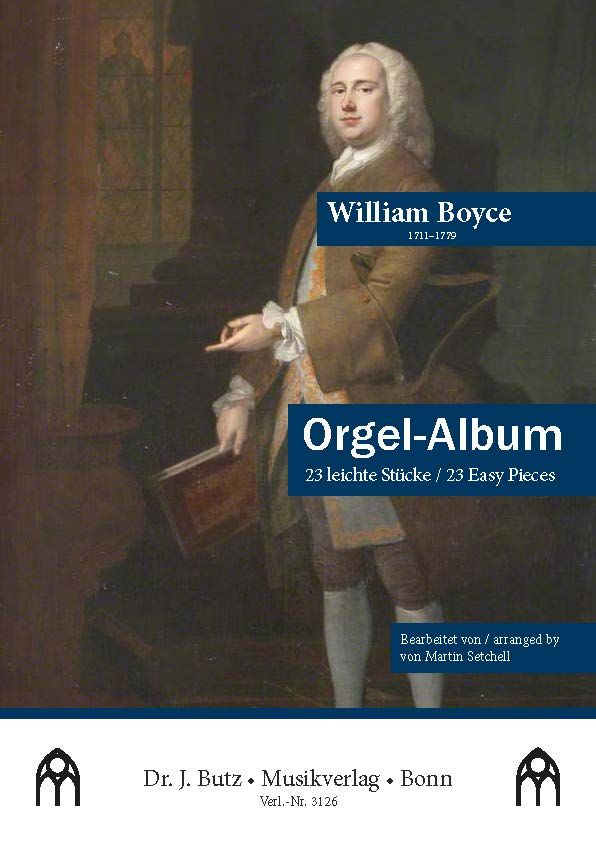
WILLIAM BOYCE ORGAN ALBUM [E–M]
arr. Martin Setchell
Butz-Verlag 3126 €15.00
For most organists, I expect that a William Boyce (1711–79) organ album means just one thing: the two-stave volume of 10 Voluntaries for organ or harpsichord, published posthumously. For this mostly three-stave volume, Martin Setchell has turned to Boyce’s 8 symphonies and 12 oratorios plus overtures to various odes and masques, and selected 23 movements that work well for organ. Here are gavottes, minuets and a jig, Vivaces, Allegros and Larghettos, a March and a Spirituoso, along with a ‘Symphony’ for The Souls of the Righteous, written for the funeral of George II in 1760. Aside from those last-mentioned movements, the mood is mostly major key and jolly. Only original dynamic marks are shown. The resulting clean look matches that of the original organ voluntaries – players who enjoy those, but regret there only being 10 of them, will welcome this enrichment of the repertoire.
Julian Elloway
MIXED COMPOSER ANTHOLOGIES
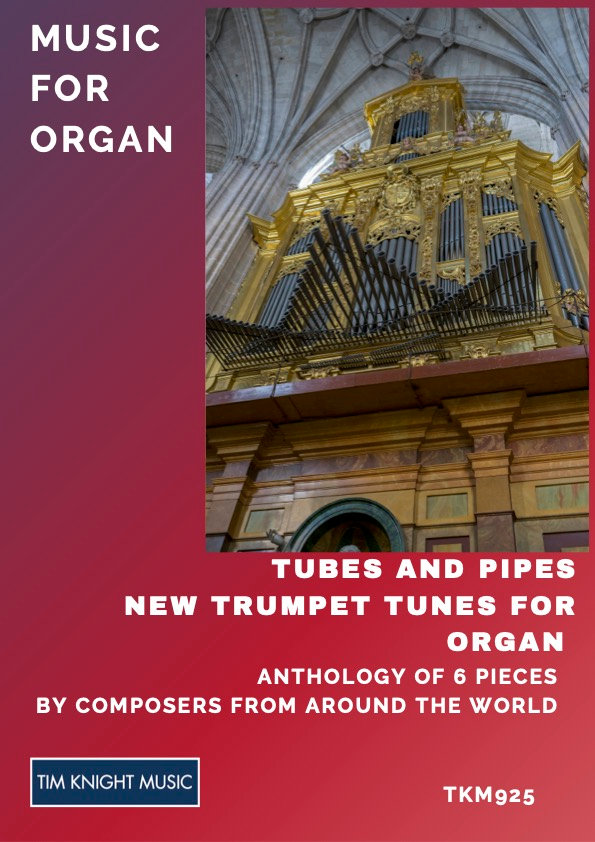
TUBES AND PIPES: NEW TRUMPET TUNES FOR ORGAN [M]
Tim Knight Music TKM925 £14.95
This little anthology of six pieces, all featuring solo trumpet stops, opens with an immediately attractive Trumpet Tango by Phil Lehenbauer, which does exactly what its title says. Giles Taylor’s stately Processional and Derry Bertenshaw’s lively Syncopated Trumpets do not have fanfare figures in their solo lines and could work well with other combinations of stops on a two-manual instrument. David Lasky’s Trumpet Rondeau in C is an effective festive recessional. Leigh Harrison contributes a Majestic March with a grand and stately feel. Josh Ring’s Trumpet Tune on ‘Simple Gifts’ treats the tune freely and almost as a dance: it is a refreshing approach after some of the heavier pieces here.
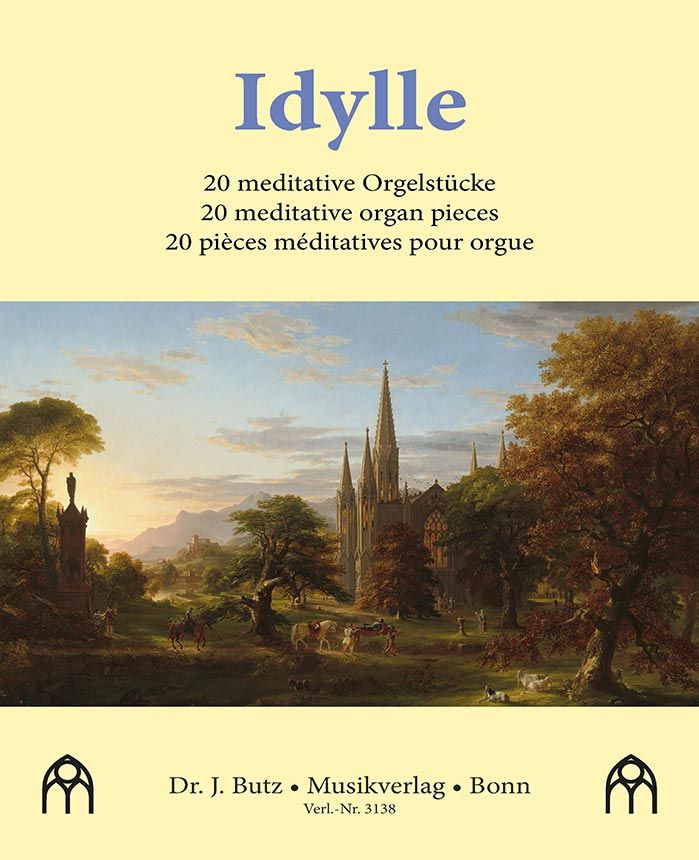
IDYLLS: 20 MEDITATIVE ORGAN PIECES [E/M]
ed. Hans-Peter Bähr
Butz-Verlag 3138 €20.00
Two of the pieces in this volume of new music commissioned by the publisher are titled Communion, making clear their intended use. Others include Idylls (Robert Jones and Bernard Wayne Sanders), Meditation (Lothar Graap, Hans-André Stamm and Margaretha Christina de Jong), Andante Religioso (Carsten Klomp) and Cantilena (Martin Setchell), choosing composers whose names are more likely to be known to readers of this magazine. Peter Planyavsky cannot resist calling his dreamy communion meditation Planys Angelicus. Wolfgang Reisinger combines a berceuse with a gentle waltz in Berceuse viennoise. The 20 different composers were given specific criteria in terms of duration (three to five minutes, or longer if with optional cuts indicated), moderate difficulty, and an overall contemplative mood using preferably a neo-Romantic musical language. Two manuals are required for some of the pieces, but apart from that they are suitable for the smallest of instruments. There is infrequent indication of registration or dynamics, and players are given some freedom to provide their own. It is a useful collection for players expected to fill in during quiet liturgical moments and who do not want to improvise; there is considerable variety and invention in the 20 short pieces.
Duncan Watkins